Curbside charging
Charge where you park
Park. Charge. Go to bed.
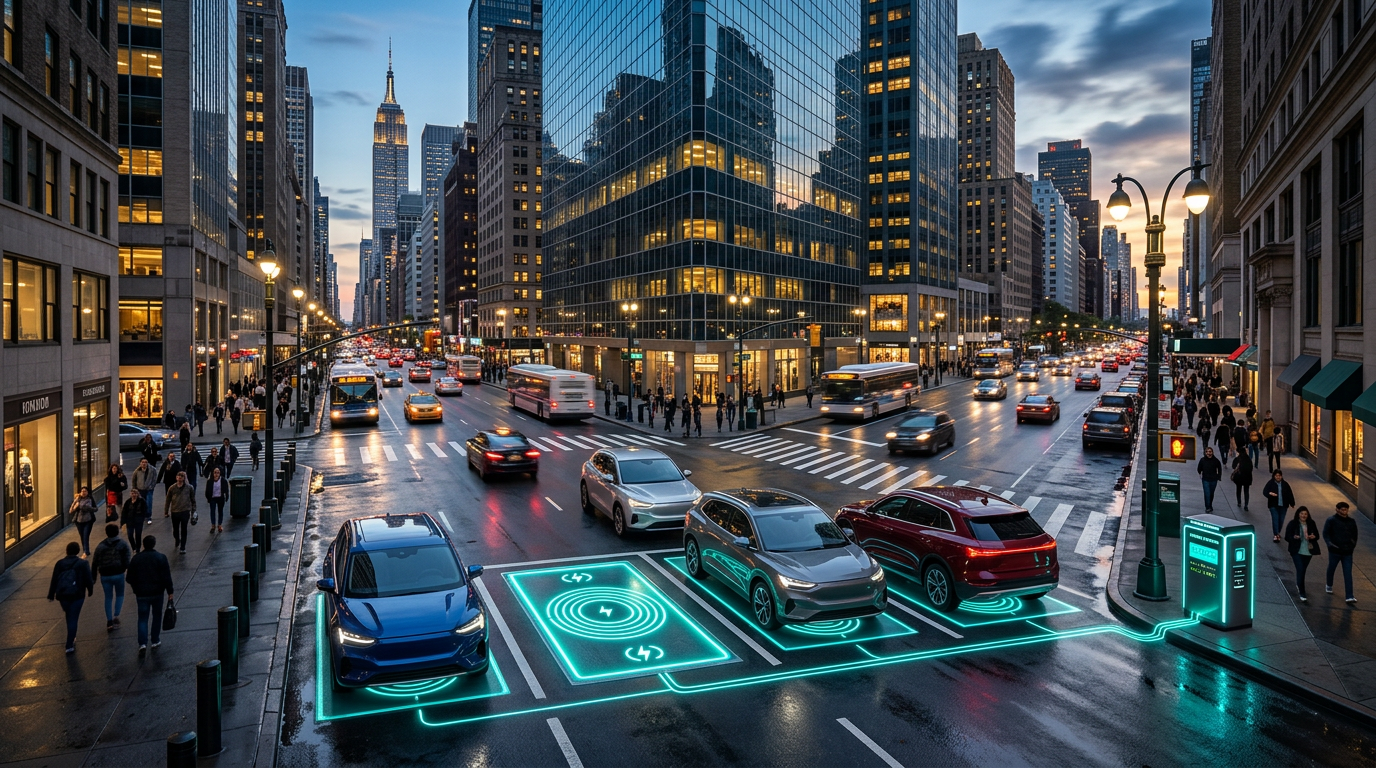
Most New Yorkers who own a car park it on the street. There is no garage to plug into, and a cable across the sidewalk is a lawsuit waiting to happen. So put the charger under the car instead: a plate in the curb lane, a receiver on the car, and software that shares one street feeder across the whole block overnight.
The idea is a little goofy. The numbers are not.
How it works
Four parts, no cables
- 01
A plate in the curb lane
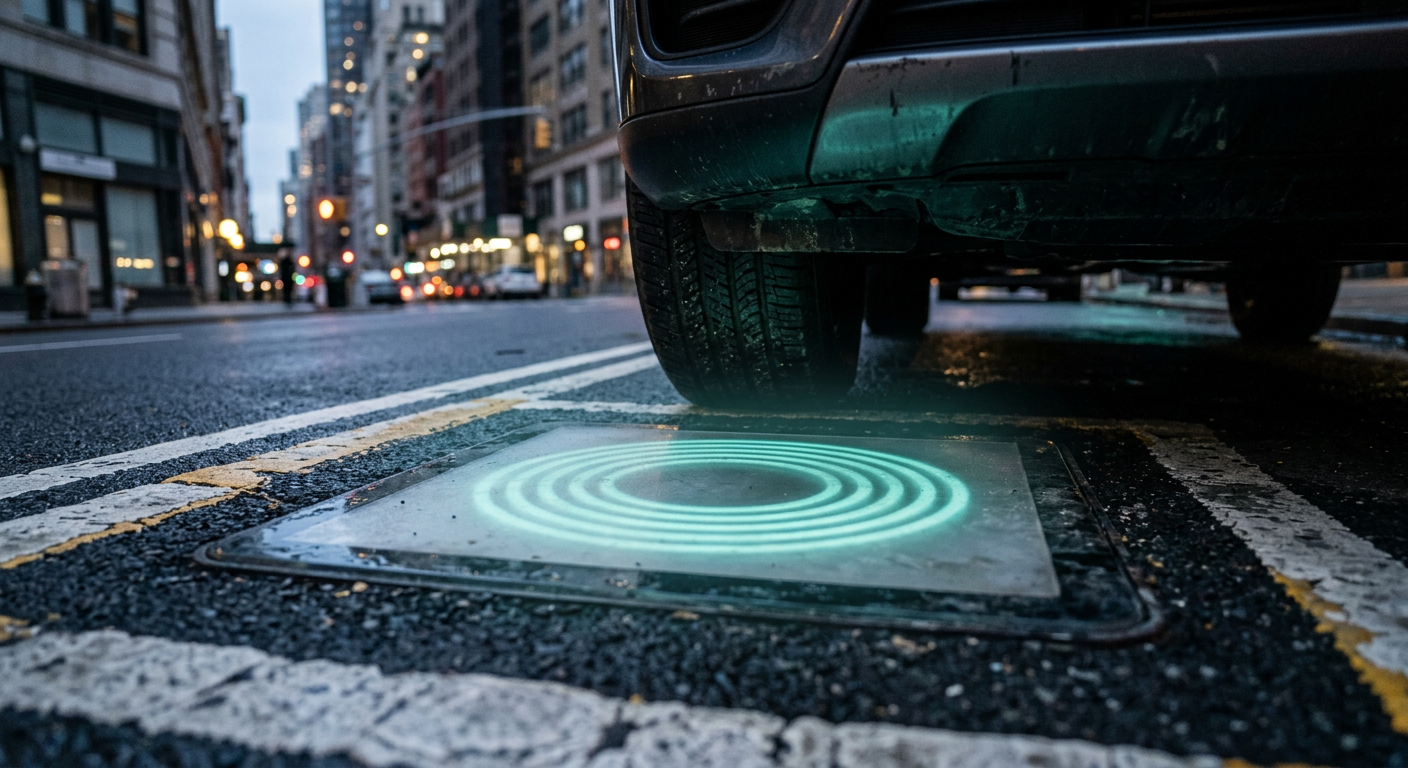
A charging pad sits flush in the parking lane, in a marked slot with a wheel guide. Snowplows roll over it; nobody trips on a cable because there is no cable.
- 02
A receiver under the car
A bolt-on receiver feeds the car's own charge port, so the car thinks it is plugged in. No battery surgery. One kit per car model.
- 03
Software shares the block
Every plate on the block draws from one street feeder. The software splits that power across every parked car overnight, so everyone wakes up charged instead of the first five.
- 04
Pay per kWh, not per hour
You pay for the energy you took, billed like a utility. The slot is for parking and charging, so nobody camps on it with a full battery.
One block, one night
Does everyone wake up charged?
The limit on a city block is not the plates. It is the power line feeding them. Compare the dumb way (first cars in get full power, everyone else waits) with load sharing (everyone gets a fair slice).
Everyone on the block wakes up with enough for tomorrow, on the same street feeder. That is the whole trick: software, not a bigger cable.
Illustrative: 3.5 miles per kWh, 92% plate efficiency when parked well. Real feeder capacity comes from Con Edison, block by block.
Park like you mean it
How far off can you park?
Inductive charging only works when the pad under the car sits over the plate in the street. The standard allows roughly 10 cm either way. Slide the car and see what happens.
This is why the slot design matters as much as the plate: wheel guides and a painted box do most of the work. Illustrative figures.
The honest part
What stands in the way
Almost no cars have receivers
That is why the retrofit kit comes first, starting with fleets you control, one car model at a time.
Plates cost more than plugs
Several times a curbside wired charger today. Build every curb rebuild plate-ready (conduit and a recessed bay) so the plate drops in later.
Winter, salt and plows
The plate must sit flush, drain water and survive snowplows and road salt. Proven on test roads, not yet on NYC streets.
The street belongs to the city
NYC DOT controls the curb and Con Edison controls the feeder. Curbside wired charging pilots already exist, which is the door to knock on.
Featured · Where the power comes from
The Urban Energy Loop
A plate is only as clean as the grid behind it. The Energy Loop is the whole circuit for a Brooklyn district: local waste becomes electricity, a resilient DC microgrid carries it, the curb plates deliver it with no cable, and the stack carbon gets captured along the way. It's a live simulation you can run: throttle the plant, island a node, or trip a safety cutoff and watch it spread.
- 01Waste to powerPower Island plant
- 02DC microgridIslands when the grid fails
- 03Curb platesThis page
- 04Carbon captureStack CO2 held back
Same system · Who pays for it
Power Up New YorkThe same energy loop seen from the negotiating table: city, utility, residents and investors each decide how the plant, the microgrid and the curb plates get funded.Layers of seriousness
The same ladder, everywhere
Curb charging, astronaut training and the harbour assets all climb the same four rungs. Nothing skips a rung, and anything touching people, power or the water goes through licensed partners and the agencies.
| Rung | Curb charging | Astronaut training | Harbour assets |
|---|---|---|---|
| 1 · Paper | This dashboard: the numbers for one block, one feeder, one night. | The free online cadet tier and the classroom, running today. | The Harbour Asset instrument: flood defence and launch pad on one hull. |
| 2 · Demonstrator | One plate, one retrofitted car, one private slot. Low voltage on the bench first. | Simulators and ground drills run by licensed training partners. | A scale model barge and a tank test with a naval architect. |
| 3 · Pilot | One NYC block with DOT and Con Edison, plus a fleet you control. | A founding cohort on site, under partner certificates and insurance. | One barrier section and one berth, with USCG and USACE on board. |
| 4 · City scale | Every new curb rebuild is plate-ready by default. | A standing training campus that funds the rest. | A harbour line that defends the city and hosts launches. |