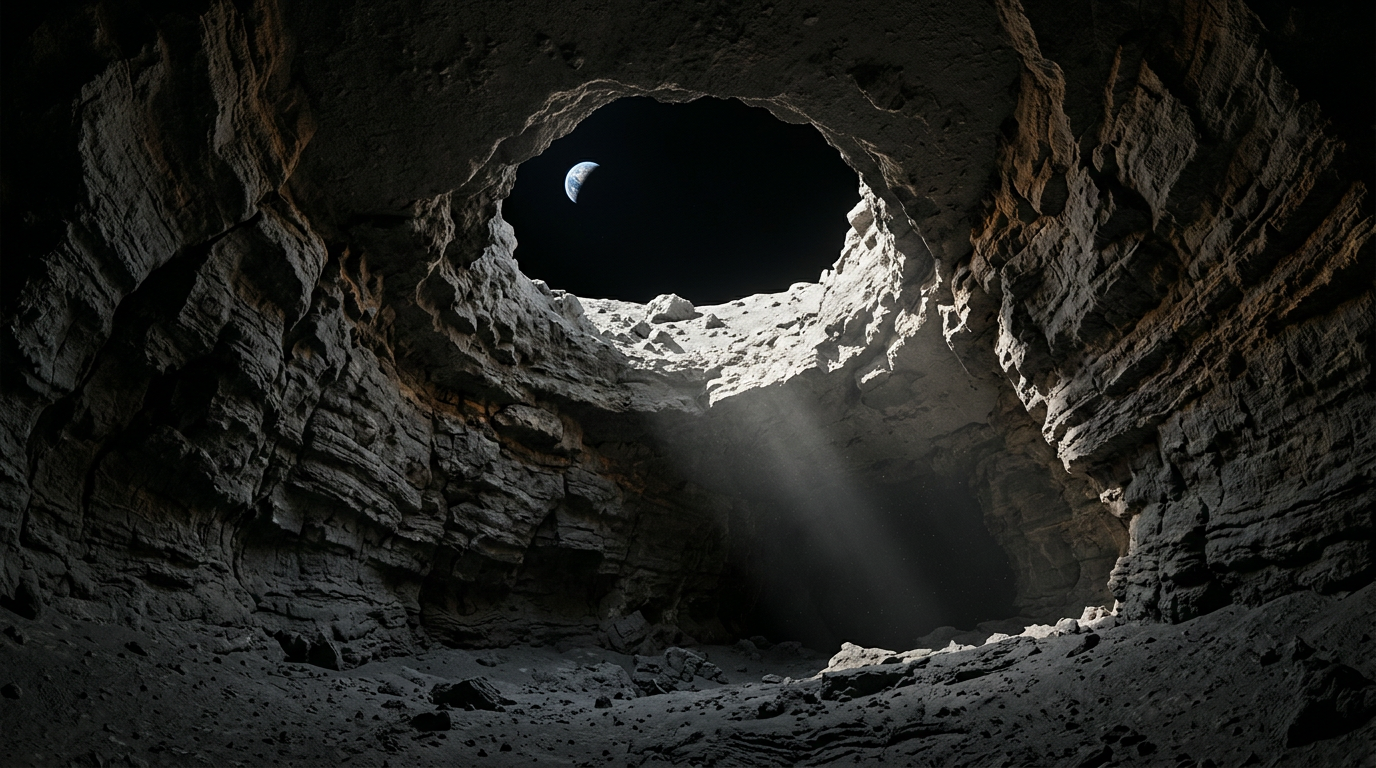
Caves on the Moon, Mars and Mercury
Take shelter where each world already offers it.
Instead of building an Earth-like bubble on an open surface, we go underground. The rock that shields the camp is also the rock that tells us why the Moon, Mars and Mercury are the way they are.
A shelter
Rock overhead blocks radiation and small meteorites. Below the surface the brutal day and night fade into a steady, mild climate.
A laboratory
Cave walls expose layers that took billions of years to form. The geologist studies the very rock that keeps the crew safe.
An old idea, carried forward
People have always dug in for warmth.
Inuit families built sod houses, the qarmaq, dug partly into the ground. Snow houses were entered through a tunnel set lower than the sleeping floor, so cold air sank into the tunnel and warm air stayed with the people.
The same principle works on the Moon, only stronger. With no air to soften it, the surface swings hundreds of degrees between day and night. A short way down, that swing nearly vanishes.
Try the slider. It shows why a camp below ground needs far less energy to stay comfortable.
Dig down, live in
How the Moon's day and night fade with depth
Daytime high
+125 °C
Night-time low
-165 °C
Daily swing
290 °C
Within about a metre the swing all but disappears. A cave goes further: inside the Tranquillity pit the shade is thought to hold near 17 °C.
Illustrative model shaped on Apollo-era soil readings. Real values vary with latitude and soil.
Three worlds, in order
Why each world is worth digging into
The Moon
Close enough for near real-time control, with more than 200 known pits. In 2024 a radar study confirmed a real cave passage leading off a pit in the Sea of Tranquillity.
Conditions
- Surface swings from about +120 °C by day to about -170 °C by night
- Inside the Tranquillity pit the shade holds near 17 °C
- No air and no magnetic field, so rock is the best shield
What the rock could tell us
How much heat the Moon still holds
Apollo 15 and 17 measured heat rising from inside, but only at two sites. Cave walls offer new places to listen.
A buried diary of the Sun
Soil layers sealed under old lava flows hold billions of years of solar wind. Cave walls expose those layers without drilling.
Where the water came from
Cold, shaded rock keeps ice and other frozen chemicals that point back to comets, asteroids or the Moon itself.
The natural first camp: short trips, steady shade and a clear science return.
What the cold keeps
Shaded rock is a freezer for the early Solar System.
No open sea can last on the Moon, Mars or Mercury: liquid either boils away or freezes. But frozen chemistry survives in the shade, including alcohol. Here is where it has really been found.
Lunar polar ice
Traces of methanol
In 2009 NASA's LCROSS mission struck a shadowed crater. The plume held water and other frozen chemicals, with traces of methanol among them.
Comet Lovejoy
Ethanol, the alcohol in drinks
In 2015 astronomers saw the comet giving off ethanol as it warmed near the Sun.
Sagittarius B2
A vast cloud of alcohol
A gas cloud near the centre of our galaxy holds an enormous amount of alcohol, spread thin as gas.
Titan, moon of Saturn
Real seas, not of water
Lakes and seas of liquid methane and ethane, the largest being Kraken Mare. NASA's Dragonfly is due there in the 2030s.
Any discovery in a cave would most likely be one of these preserved ices, telling us where each world's water and carbon chemistry came from.
How the cave is studied
Six proven ways to read a world from the inside.
None of these are new. Each has already flown. What changes is where they sit: inside a sheltered cave, running for years instead of days, with the camp itself as the instrument.
Heat-flow probe
How much heat still rises from the interior, and how fast the rock passes it along.
Apollo 15 and 17 on the Moon; InSight on Mars
Ground-penetrating radar
Buried layers, voids and ice, without digging a single hole.
Chang'e 3 and 4 rovers; Perseverance (RIMFAX)
Seismometer
Quakes and impacts, which reveal the crust, mantle and core beneath.
Apollo seismic network; InSight (SEIS)
Lidar and photo mapping
A 3D model of the cave walls and ceiling, so every sample has an exact place.
Tested in Earth lava tubes by NASA's BRAILLE project
Ice-hunting spectrometers
Hydrogen and frozen chemistry in shaded ground, from orbit or up close.
Lunar Prospector; Lunar Reconnaissance Orbiter
Core samples
Layer by layer history: lava flows, solar wind, impacts, in the order they happened.
Apollo drive tubes and drill cores
The tug as a scout
Look first, land second, bring the rock home.
The same space tug that delivers and refuels can work for the camp. It finds the caves, ranks them for water and useful elements, drops the scouts, relays their data and carries samples back.
- 01
Find the doorways from orbit
Cameras spot skylights and pits. A thermal camera finds them at night, because a pit stays warmer than the surface around it. Radar and gravity maps show where a hollow tube runs beneath.
LRO, GRAIL, Mars Odyssey (Arsia Mons skylights)
- 02
Prospect for resources
A neutron spectrometer senses hydrogen, a sign of water ice. Infrared reads hydrated minerals. Gamma rays reveal iron, titanium and other elements. Together they rank sites before anyone lands.
Lunar Prospector, LRO LEND, Chandrayaan-1 M3
- 03
Deliver the scouts
The tug carries small landers and rovers to the right orbit and drops them close to a chosen pit rim, so each one spends its fuel on landing, not on getting there.
Rideshare delivery is flying today
- 04
Stay overhead as the relay
Radio cannot reach far inside a cave. The tug parks above the site and stores and forwards data between the camp and Earth on every pass.
Mars orbiters relay most rover data
- 05
Bring the samples home
A small ascent stage lifts the samples off the surface. The tug meets it in orbit, takes the sealed container and carries it back toward Earth, the same handoff China used to return Moon samples.
Chang'e 5 (2020), Chang'e 6 far side (2024)
The honest limit is fuel. Reaching lunar orbit from low Earth orbit takes about 4 km/s. Mars takes far more, and Mercury is hardest of all: BepiColombo needed seven years and nine flybys. So the Moon comes first. Mars samples also face strict planetary-protection rules, and any resources would be used under the Outer Space Treaty and the Artemis Accords.
For classrooms and crews
Every camp is also a classroom.
The same questions a geologist asks on the Moon can be asked in a schoolyard. Three lessons that need no special equipment, each tied to a science standard.
- 1Grades 5-8 · MS-ESS2
How deep is warm?
Bury three thermometers at different depths in the schoolyard and log them morning and afternoon. Compare the swing with the depth slider above: same physics, smaller numbers.
- 2Grades 4-8 · MS-ESS1
Read the layers
Build a layered jar of sand, soil and gravel, then core it with a clear straw. Students order the events, the same way geologists read a cave wall.
- 3Grades 6-10 · MS-ETS1
Map a dark room
Turn off the lights and map a classroom or hallway with a flashlight, tape and a phone's depth scanner. Then decide where a camp would be safest, and defend it.
Where crews already train on Earth
Lava Beds, California
NASA's BRAILLE team practised robotic cave mapping and life detection in these lava tubes.
Lanzarote, Canary Islands
ESA's PANGAEA course trains astronauts in planetary geology on volcanic ground.
Sardinia, Italy
ESA's CAVES course has crews live and work underground for days, as a team.
Why go underground
The benefits, so far
Protection the world already provides
Metres of rock overhead block radiation and small meteorites, with nothing to launch and assemble.
A steady, mild climate
Below the surface the daily swing fades away, so less energy goes to heating and cooling.
Every camp is an instrument
The walls that shelter the crew are the rock the science comes from. Living and learning happen in the same place.
Care for what we find
A sealed, quiet camp disturbs less, which matters most where a cave may hold traces of life.
“We take shelter where each world already offers it, and study the rock that shelters us.”
A research direction, not a scheduled mission. The Moon comes first, Mars follows with strict care for possible life, and Mercury is a long-horizon goal. Cave data would come home over the same store-and-forward network shown on our platform page.